
wartamoro.com, The bikini, a garment barely there yet undeniably impactful, has been a summer staple for nearly eight decades.
Its creation sparked controversy and admiration in equal measure.
Late fashion editor Diana Vreeland declared it: “The most important thing since the discovery of the atomic bomb."
From its inception in the 1940s to its modern iterations, the bikini's journey reflects evolving social norms and the enduring power of a little piece of fabric.
Here's a look back at its evolution.

The origin of the bikini
Ever since the mid-19th century, swimsuits have been gracing the waters of Normandy and Biarritz by the sea-bathing elite. But in the summer of 1946, a seismic shift in swimwear took place.
Taking inspiration from the first American nuclear test at Bikini Atoll in the Pacific, French engineer-turned-textile-manufacturer Louis Réard dropped a fashion bomb on post-war France: the bikini.
During his visit to the beaches of Saint-Tropez, Réard noticed women pulling down their swimwear to achieve a more extensive suntan — an observation that inspired him to design a bikini exposing the midriff entirely.
The strikingly simple design was first showcased at Paris's Molitor pool, with modeling done by Micheline Bernardini, a nude performer from the Casino de Paris who was the sole woman brave enough to sport this provocative garment.
Consisting only of small pieces of fabric adorned with snippets from Bernardini’s fan letters, what became known as the "world's tiniest swimsuit" revealed her figure prominently and—most controversially—the indentation of her belly button. During that period, this aspect of one's anatomy was deemed much too personal for general viewing. The belly button, linked emblematically to maternity, continued to be regarded as an element belonging strictly within the confines of privacy.
Enclosed in a small metallic box measuring only 6 centimeters across, and promoted as "the first anatomical bomb," the bikini aimed to disrupt post-war sensibilities regarding modesty.
One of its earliest supporters was Brigitte Bardot , who created a stir in 1953 by sporting a modest floral bikini on the shores of Cannes.
The young defiance of this 18-year-old performer contributed to transforming the bikini into an emblem for a generation adopting liberty, enjoyment, and a swiftly evolving consumer society.
1960s

Come the 1960s, bikinis were still enjoying a surge in popularity, despite still being forbidden on some European beaches.
This was largely down to Hollywood. In the James Bond film Dr. No (1962), Ursula Andress stepped out of the sea wearing an iconic white belted bikini, and the moment certainly made waves.
Channel 4 ranked it as the top bikini moment in cinematic history, and in 2001, the swimsuit was auctioned off for $61,500. Film critic Martin Rubin characterized this instance as a "pivotal point in the loosening of screen eroticism during the swinging sixties."
In that selfsame year, actress Sue Lyon reclined on the lawn wearing a flowery two-piece swimsuit in "Lolita," whereas Raquel Welch embraced her primitive side with a furry bikini in "One Million Years B.C." (1966). Such iconic scenes significantly contributed to making bikinis fashionable worldwide.
However, in France, the bikini did not gain full acceptance until 1968. This was when social rebellion and the emergence of feminism played crucial roles in reshaping norms around women’s attire and its implications.
Once merely a scanty beach garment, the bikini transformed into a discreet form of rebellion—a means for women to assert control over their own bodies, shed traditional notions of restraint, and enjoy unrestricted movement—be it while swimming, lounging in the sun, or just existing.
What was once considered shocking had transformed into an emblem of freedom.
1980s
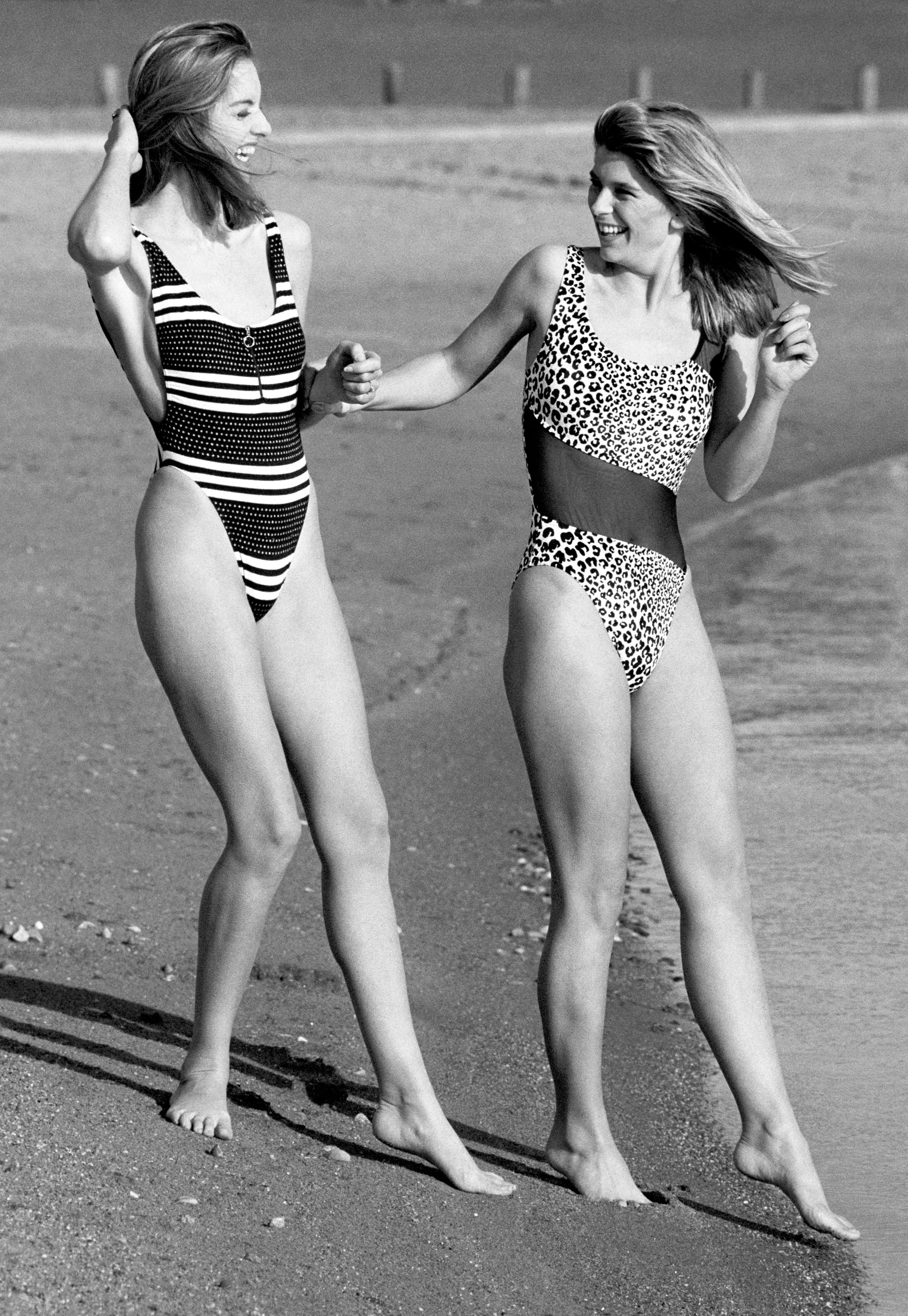
By the 1980s, the bikini made up 20 per cent of swimsuit sales, more than any other swimwear model in the US.
However, as skin cancer awareness grew, sales of the skimpy bikini decreased dramatically. Suddenly, it was all about the high-rise one pieces.
In addition to one-piece swimsuits, variants like the 'tankini' and 'camikini' gained popularity. These styles included longer tops that covered the midsection and ended around the hips.
The likes of Baywatch’s Pamela Anderson And Sports Illustrated model Cindy Crawford turned into swimwear icons, sporting deep-cut one-pieces alongside high-rise bottoms.
1990s
As more minimalist styles started shaping the fashion world and one-piece suits became emblematic of Eighties sportswear, the bikini made a significant resurgence.
On this occasion, premium brands started reshaping the bikini into extravagant fashion declarations.
In 1996, Chanel made it smaller and added their iconic logo before showcasing it on the runway through the legendary supermodel Stella Tennant.
The following year, Tom Ford at Gucci took things even further with a barely-there ombré thong bikini adorned with a bold metal G – designed for all genders, and made to be seen.
2000s – present day

Today, the bikini remains a controversial piece of clothing, still finding itself under censorship.
In 2013, an advert featuring Pamela Anderson dancing in a bikini was banned by the British Advertising Standards Authority for degrading women.
That same year, Cambridge University prohibited the Wyverns Club of Magdalene College from organizing their traditional yearly event involving bikini-clad participants engaged in jelly wrestling.
However, as designers grow more inclusive and innovative with their creations—the bikini appears to have entered its prime era.
A representation of liberty and emancipation—the bikini continues to be one of the most sought-after segments within the fashion sector, with an estimated value of approximately $811 million.
No matter what shape it takes next, one thing is clear: the bikini is here to remain.
The Independent has consistently maintained a worldwide viewpoint. Rooted in strong foundations of exceptional international coverage and analysis, The Independent now boasts a readership that would have been unimaginable at its inception as a newcomer in the UK media landscape. In this era, for the first time since the conclusion of the Second World War, these core principles—pluralism, rationality, progressivism, humanism, and international cooperation—are facing challenges globally. Despite this, The Independent continues to expand its influence.
Posting Komentar